Showing posts with label Deity Research. Show all posts

Friday, November 14, 2014

Friday, January 27, 2012

A few stories not dated in the mirror book - Story II: Guan Yu, the Saint of Force

THE MEDITATION (early June 2011)
It was around this period that I was reading the Tibetan Book of Living and Dying and seemed to then engage with Buddhist deities through trance meditation, such as the previous entry on the White Tara from February last year and also with Quan Yin, which I haven't written about as yet.


The meditation began on top of a cloudy mountain, so cloudy that I had to float down through the air cross-legged in order to move into the realm.  I floated above a rocky pathway, down past a Chinese man carrying two pitchers of water across his back and around to the precipice of the mountain leading to many sets of stairs. From the top of the stairs you had an incredible view of the bay below where three waterfalls came into the crescent-shaped bay and fell gracefully from a great height into the ocean.  I continued to float down to the bay as a Chinese soldier with long hair in a ponytail crouched on the sand facing out to the horizon as though he was paying homage.  He wasn't wearing a helmet nor was he wearing anything around his torso at all, as though as a warrior he had removed them for he knew we would not fight and also to relax in his own worship as he meditated on the beach.  He had sharp lines for eyebrows, acne scars on his lower cheeks and had very beautiful long eyes.  He wore the lower half of his warrior suit along with his boots.


"Who are you?" I asked, bowing to him.
"Guan Yu," he replied.
I hadn't heard of this diety before and wasn't sure what to expect from him, but from what I could tell his intentions were pure.  He crouched down again, extending one hand out so that large red playing cards formed a walkway above the ocean, which he invited me to walk over.  I walked over the pathway which lead to a large whirlpool in the ocean which danced above in circles on one of the cards for a time, then I jumped into it.  I danced within the whirlpool and looking up I could see many moons racing above my head as though time was speeding up intensely, hundreds of years passing by.  Then the walls of the whirlpool caved in and I surrendered to its dance, being spun around, accepting a death for a new beginning.  After some time the whirlpool formed again and I came above the surface to see a modern Chinese city where the bay used to be without the hills and its waterfalls.


SYMBOLISM
Three waterfalls: Guan Yu's was a prominent general of the Shu Kingdom in the Three Kingdoms Period, thus the three waterfalls may have symbolised each kingdom coming in to one point.  It may also be symbolic of the three phenomenon truths from the Tientai school which was founded after a disciple met Guan Yin a:


  • Dependent reality: A phenomenon is produced by various causes, its essence is devoid of any permanent existence.
  • Phenomenal existence: This existence is temporary, and has its limitation.
  • Middle: This truth of the middle is equated with true suchness, and it can not be found elsewhere than in phenomena. According to this truth, Dependent reality and Phenomenal existence are one.
And the only way to obtain the full awareness of the above truths is the Three views (or three insights):
  • Emptiness: Phenomena posses no independent reality and they can not exist without other factors, therefore nothing is eternal.
  • Unreality: Although a phenomenon has the apparent existence of phenomena and can be perceived by the senses, because its nature of emptiness, this phenomenon is temporary and unreal.
  • Middle Way: Since a phenomenon is blended of emptiness and unreality, it is incorrect to view the truth in any of the above two poles. The proper action is to view a phenomenon and its parts as a whole, all phenomena are merged and contain one another.


Red Playing Cards: "A well known story of Guan Yu is how he got a poisoned arrowed to the arm and had to get surgery. Guan Yu calmly played a game of solitaire while receiving the needed treatment on his arm (1)."


A VERY SHORT HISTORY OF GUAN YU, CHINESE SOLDIER, 160 to 219AD
Called upon in China to protect social order, Guan Yu was deified as a saint for policemen and I adore one of his many titles "General who rocks the bandits"!  I saw Guan Yu at about the age of 23, which apparently was the age when he ran away from his home town having slain a man who was harassing a woman.  After this age he became a great warrior.  Read more about the life of Guan Yu here.


According to the Buddhist account, in 592, Guan Yu manifested himself one night before the Tripitaka Master Zhiyi, founder of the Tientai school of Buddhism, with a retinue of spiritual beings. Zhiyi was then in deep meditation on Yuquan Hill when he was distracted by Guan Yu's presence. After receiving Buddhist teachings from the master, Guan Yu acquired the Five Precepts. Henceforth he became the guardian of temples and the Dharma. Legends also claim that Guan Yu assisted Zhiyi in the construction of the Yuquan Temple, which still stands today. (2)

Dharma: that which upholds, supports or maintains the regulatory order of the universe means Law or Natural Law and is a concept of central importance in Indian philosophy and religion. As well as referring to Law in the universal or abstract sense dharma designates those behaviours considered necessary for the maintenance of the natural order of things

The five precepts: to abstain from harming living beings, stealing, sexual misconduct, lying and intoxication.

WHAT DID I TAKE FROM THIS?
Well, having only just looked up what the five precepts are, I believe the journey taught me to take better care of myself: by not submitting myself to sexual misconduct by putting myself into dangerous and precarious sexual situations as I have in the past, to not harm others in any way - including in thought, to not steal even the smallest thing - even food, to never lie and be transparent in how I express myself and to not get intoxicated - and thankfully I don't drink!  I have met with him in meditations since with he and I practising sword fighting which I believe suggests the discipline and clarity of mind required for and a result of the five precepts.  Now that I have finally looked up the five precepts I intend to stick with them - and have been very good with those ever since having met this diety anyway, so I certainly hope that was his influence!


Sources:
(1) The Young Polytheistic
(2) And other information on Tientai 

Friday, August 12, 2011

August 13 - the day of Aradia, Diana and Hecate - the maiden, mother and crone

Aah the 13th of August and on the full moon at that! It was said that Aradia, in the form of a physical woman on earth was born on the 13th of August, the day of Diana in the year 1313 who then roamed the earth teaching Witchcraft, aptly named 'La Bella Pellegrina' or 'The Beautiful Pilgrim.'  A great deal more detail on Aradia can be read in my previous post here.  You can also read a brief description about Hecate here.

In the northern hemisphere, Hecate is honored by leaving an offering at the crossroad - the roads between life and death which she represents.  Take a plate you won't mind 'losing' to the crossroads with goods such as honey (lavendar honey is the best), eggs and garlic out once darkness has fallen -  say your invocation to the Goddess of Witchcraft and leave the plate there and do not go back for it - in fact, once you turn around and journey back home, don't look back to that crossroad.  In the home, burn patchouli incense, a black candle and performing divination at midnight.  Hecate observes all activity & assists at night, so perform all of the above at night time.

Seeing as it's a full moon you may feel inspired upon drawing down the moon to repeat the charge of the goddess in its original form from Aradia: The Gospel of the Witches by Charles Leland below (before it was changed by Doreen Valiente and Aleister  Crowley before her) to honor both Aradia and Diana:

Aradia:
When I have departed from this world
Whenever ye have need of anything
Once in the month, and when the moon is full
Ye shall assemble in some desert place,
Or in a forest all together join
To adore the potent spirit of your Queen,
My mother, great Diana. She who fain
Would learn all sorcery yet has not won
Its deepest secrets, them my mother will
Teach her, in truth all things yet unknown.
And ye shall all be freed from slavery,
And so ye shall be free in everything;
And as a sign that ye are truly free,
Ye shall be naked in your rites, both men
And women also: this shall last until
The last of your oppressors shall be dead;
And ye shall make the game of Benevento,
Extinguishing the lights, and after that
Shall hold your supper thus

Monday, February 7, 2011

Meeting the White Tara

A few days ago I had a wonderful meditative experience.  This is particularly interesting after having spent some time reading The Tibetan Book of Living and Dying of late.  As per usual, when I meet a new character in these meditations I usually haven't a clue who they are.  Normally my meditations lead me to a temple of Hermes Trimegistus - a large stone, sandalled foot broken at the ankle to what would have been a massive statue of Hermes Trimegistus facing out to the ocean.  This time though, I remained facing out to the ocean with my back to the temple and the waves started to behave strangely, curling in an unusual way.  The sun was directly in front of me on the horizon like the morning sun and the moon was directly above my head.  From the horizon I could start to see the waters parting and slowly, a beautiful woman with long wavy white hair, a Nepalese face covered in white clay in an all-white costume came towards me very calmly, serenely.  I patiently waited for her and she embraced me in a beautiful hug, where she then proceeded to put me on like a piece of clothing by slipping her hand through my back like a puppet with the rest of her body following until we were merged as the one being.  I felt the coolness of water throughout me, a white glow and wonderful feeling of peace.  Who was this Goddess?  I then looked her up...


Sometimes called Mother of the Buddhas, White Tara is meant to have so much compassion for humankind that she exudes more love than a mother for her child.  Tibetan Buddhists refer to her as the Mother of Liberation as the word Tara itself is derived from the root 'tri' (to cross), hence the implied meaning:' the one who enables living beings to cross the Ocean of Existence and Suffering'.   She protects her followers on their spiritual journey to enlightenment, particularly to overcome obstacles which may inhibit the practice of religion. 

Many myths surround her, but always as an incredibly pious character whether those stories had her derive from an actual person or purely in the form of deity.  One myth tells of the White Tara being born from the tear of Avalokiteschvara, also known as Chenzering, who the Dalai Lama is a reincarnation of.  One day Avalokiteshvara looked upon the world with such compassion that he began to cry over the suffering of mankind in its imbalance.  Tears from each eye created the White Tara and Green Tara respectively.  Another similar myth states that Avalokiteshvara cried an entire lake where a fully opened lotus formed and the White Tara emerged like Venus from her shell, as did Green Tara’s lotus, but not completely open.  White Tara was born into the world to relieve suffering and provide longevity to her followers for the long journey through the Ocean of Suffering.

Green Tara, with her half-open lotus, represents the night, and White Tara, with her lotus in full bloom, symbolizes the day. Green Tara embodies virtuous activity while White Tara displays serenity and grace. Together, the Green and White Taras symbolize the unending compassion of the goddess who labors day and night to relieve suffering. (1)

Some believe that the Green and White Taras represented ancient royalty:

In seventh-century Tibet, Tara was believed to be incarnated in every pious woman. She especially came to be associated with two historical wives of the first Buddhist king of Tibet, Srong-brtsan-sgam-po (d. 649). His wife from imperial China was said to be an incarnation of White Tara, while the king's Nepalese wife was an incarnation of Green Tara. It may be that the desire to regard both these pious women as incarnations of Tara led to the concept of the goddess's green and white forms.

She is pictured as being endowed with seven eyes (on the palms of the hands, soles of the feet, and her forehead) to symbolize the watchfulness of the compassionate mind.


White Tara mantra

(text in Tibetan Uchen)

Oṃ Tāre Tuttāre Ture Mama Ayuḥ Punya Jñānā Puṣtiṃ Kuru Svāhā

Pronounced

“Omm Taraye, Tuttaraye Tooraye

Mahmah Aryoob Punya-Gnyana Pooshtim Kuru Swa-ha”

My interpretation of this chant:

Praise to Tara, Hail!  May I be blessed with wisdom, happiness & long life.  May my experiences teach the importance of living ethically and with wisdom.  May the merit my actions of compassion and devotion be felt by others, in their hearts and amongst all of nature itself.  May we all feel the wealth of these efforts. For those who live with such compassion and merit will always live in Kuru - make it so!  I will take into me the serenity and grace of White Tara in her love, compassion and piety.  Blessed Be.

Om = It represents the energy at the Ajna chakra , the third eye energy center (chakra), where the feminine and masculine currents become joined and consciousness becomes Unitary .. into the Whole Unity of existence. You will have noticed that all Mantras begin with Om .This is because Om is the supreme sound
from which creation was born.  It is the Cosmic vibrationOm is the sound that reveals all other wordsand their different meanings.  Om also has a luminous nature and reveals things.  Hence we must first contact the power of  Om for
other mantras to work and for their specific meanings to be known.  We must first contact Om to know the Guru or  Divine guiding power within us.
Therefore “Om Tāre Tuttāre Ture” = Praise to Tara, Hail!
Mama = mine.  You or you would like your friend to have long life, merit, wisdom and happiness.

Ayuh is long life (as in Ayurvedic medicine).

Punya = the merit that comes from living life ethically, and this merit is said to help one to live long and happily.

Jnana = wisdom.

Punya and Jnana are known as the Two Accumulations. In order to become enlightened we need to accumulate merit (that is, to develop positive qualities through living ethically and meditating) but we also need to develop wisdom through deep reflection. Wisdom cannot arise without a basis of merit, but merit alone is not enough for us to become enlightened, meaning that becoming a nicer person isn’t enough — we have also to look deeply into ourselves and the world around us and to see the impermanent and insubstantial nature of all things.
Pushtim = wealth, abundance, or increase.

Kuru is a mythical land to the north of the Himalayas, which was said to be a land of long life and happiness (it may have been the original northern home of the aryans). Perhaps the association with the mythical realm of Kuru doesn’t hurt when doing the mantra. But (and with due thanks to Arpad Joo’s comment below) it’s also a verb form meaning “do it!” or “make it so!” (second person singular active imperative or the root k.r if that’s of any interest to you) which is what it means here. The “make it so!” refers back to an increase in wisdom, merit, and long life (for the practitioner). We’re imploring White Tara for these things so that we can gain enlightenment and help all sentient beings.

svaha = an exclamation meaning “hail” or “may blessings be upon” and is a common ending to Buddhist mantras. So after making the rather bold request of White Tara above, we end with an equally emphatic salutation.


Sources:

Direct quote from

Text from:
http://www.visiblemantra.org/white-tara.html 

Image from:

Saturday, November 27, 2010

Aradia - the mysterious 'Messiah of the Witches' and daughter of Diana

Aradia - the Messiah of the Witches
Born: As a Goddess: daughter of Diana in pre-Christian times & as the ‘second coming’: the niece of a witch
13 August 1313 (Diana’s day of worship)
Found in: Dianic witchcraft, Italian/Strega witchcraft, Gardnerian, the writings of Janet and Stewart Farrar
Setting: The town of Volterra ,Tuscany, Italy
People who write about her: Charles Leland, Raven Grimassi
Stone: Moonstone
Number: 13
Offerings: Strega liquore, walnuts, rue and tools of witchcraft and divination
Famous for: The Gospel of the Witches, from which The Charge of the Goddess derives from as well as many other rituals which feature in Wicca


Top:
Aradia ‘The Beautiful Pilgrim’
(artist unknown)

Bottom:
Herodias the biblical figure & Jewish princess of the Herodian dynasty
by Paul Delaroche

I first came across Aradia in Janet and Stewart Farrar’s AWitches Bible whose coven worshipped Aradia and Cernunnos. For some bizarre reason I’d never heard of her and decided to do some more research using this to find out whether there is some truth to the ‘mythological’ woman whom so few talk about. When searching through baby names and their definitions, many websites insist that Aradia is Greek for ‘Goddess of Witches’, with some believing that her name is derivative of Herodias or Erodiade, the latter being the Mediaeval Italian pronunciation of the name Herodias. Herodias, however, is a biblical character and does not replicate any characteristics of Aradia apart from the possibility that the name Aradia derives from Herodias. It is very strange that the two images above appear to almost resemble the same person – with such particular features.

Aradia was brought to our attention in recent history by Charles Leland who published Aradia: Gospel of the Witches in 1899. This text is meant to detail a true picture of Tuscan Witchcraft from this ‘messiah of the Witches.’ Many dispute the antiquity of Leland’s knowledge of Aradia, however his research also crosses over to other closely related topics in his other publications Etruscan Roman Remains, Legends of Florence and The Gypsies and Gypsy Sorcery (1) which would make him an expert on the area. Aradia has become the source of great inspiration for the Pagan Renaissance as one of the only true witches to be named openly in her era thanks to this scholar and folklorist writer. The Gospel of the Witches doesn’t give anything away about the personality of Aradia, and only implies to worship her and for her followers to work against their oppressors and to free themselves from slavery – in quite literal terms. Leland says that women of her day were often poor workers in a low wage who ultimately wanted to be freed from slavery. The Gospel also asks of their followers to work against Christianity and it isn’t clear whether the Inquisitors ever knew this, and it certainly didn’t stop them from slaughtering witches regardless.


Diana
Tis true indeed that thou a spirit art,
But thou wert born to become again
A mortal; thou must go to earth below
To be a teacher unto women and men
Who fain would study withcraft in thy school

- Gospel of the Witches
 

The writer Raven Grimassi states that Aradia was a worshipped Goddess and also walked the earth as a person called Aradia di Toscano, who adopted the Goddess’ name and taught Witchcraft. In Goddess form it is told that Diana sent Aradia to Earth to teach others the magickal arts as taught by Diana. The living Aradia is rumoured to have been born in 1313 in Tuscany in the town of Volterra, forming the grounds of Italian Witchcraft which in approximately 150 years’ time would fall into the hands of the Inquisition which famously imprisoned and killed heretics for ‘the public good’(2). In 1508, ‘Italian Inquisitor Bernando Rategno noted that a rapid expansion of witchcraft had occurred one hundred and fifty years earlier, corresponding in time with Aradia’s second coming’ (3). The living Aradia was said to have been burnt at the stake having made sure that her manuscript, the Gospel was both written in detail and kept away from the Inquisitors. It is from The Gospel of the Witches that we derive a great deal of our rites: mooncakes, the feast after the ritual, consecrating salt and being skyclad during ritual.

Nicknamed ‘The Beautiful Pilgrim’, Aradia "travelled far and wide, teaching and preaching the religion of old times, the religion of Diana, the Queen of the Fairies and of the Moon, the goddess of the poor and the oppressed. And the fame of her wisdom and beauty went forth over all the land, and people worshipped her, calling her La Bella Pellegrina (the beautiful pilgrim)(4).”

Leland’s text tells the story of Diana and her brother/lover Lucifer who bore Aradia. Indeed, this is where the Roman Catholics found their source of ‘devil worship’ in The Craft, but Lucifer was not always a Biblical figure. Lucifer is Latin for “Light Bringer” as the ‘Sun’ to balance with Diana of the Moon – the archetypal dark and light, yin and yang, with Lucifer formed from Diana herself. Diana is said to have changed herself into Lucifer’s cat and seduced Lucifer to produce Aradia. The Christians also replaced Diana of Ephesus: ‘Ephesus became a place of Mary, Mother of God’ (5) as Christian groups often quashed Pagan sites quite literally by either building over what were Pagan sites of worship or rewriting over the top of Pagan stories. The bible states that Lucifer was an angel in heaven and had been banished from Paradise for being too vain which could be seen as a way of Christian society criticising Pagans for their “vanity” or in truth for the love of their bodies in comparison to the Christians’ conservative approach to the body as a vessel of ‘sin’.

Doreen Valiente took the following verse from this text as well as Aleister Crowley’s version – which was much darker. This became The Charge of the Goddess with this original version urging you to continue until the ‘last of your oppressors shall be dead’ which we could relate in a metaphorical sense to The Ordeal we face in our first degree initiation.


Aradia:
When I have departed from this world
Whenever ye have need of anything
Once in the month, and when the moon is full
Ye shall assemble in some desert place,
Or in a forest all together join
To adore the potent spirit of your Queen,
My mother, great Diana. She who fain
Would learn all sorcery yet has not won
Its deepest secrets, them my mother will
Teach her, in truth all things yet unknown.
And ye shall all be freed from slavery,
And so ye shall be free in everything;
And as a sign that ye are truly free,
Ye shall be naked in your rites, both men
And women also: this shall last until
The last of your oppressors shall be dead;
And ye shall make the game of Benevento,
Extinguishing the lights, and after that
Shall hold your supper thus
 
Sources:

Text sources:
(1) http://www.controvers...
(2) http://en.wikipedia.o...
(3) Judika Illes, ‘Encyclopedia of Spirits’ Aradia
(4) Grimassi, Raven: http://www.stregheria...
(5) http://www.covenofthe...
(6) Leland, Charles, 1899 ‘Aradia: Gospel of the Witches’

Image Sources:
Aradia
http://www.stregheria...
Herodias
http://en.wikipedia.o...  

Monday, February 22, 2010

Baphomet and his many associations

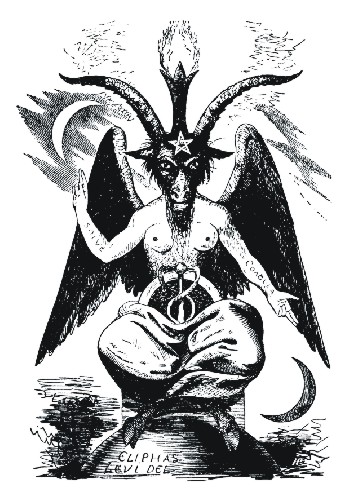
Baphomet is not commonly acknowledged within Wiccan tradition but is certainly an interesting subject.  What is intriguing about Baphomet is that he was originally a symbol of wisdom and balance, very much like the yin and yang and somehow became associated with several groups who were seen as morally bankrupt or even evil.  Many believe that this is where the image of the devil is derived from, rather than the Horned God which is worshipped in Wicca from Cernunnos and Pan.


The name Baphomet first appears around 1195 in the Occitan poem "Senhors, per los nostres peccatz" by the troubador Gavaudan Around 1250 in a poem bewailing the defeat of the Seventh Crusade, Austorc d'Ahorlac refers to "Bafomet". De Bafomet is also the title of one of four surviving chapters of an Occitan translation of Ramon Lull's earliest known work, the Libre de la doctrina pueril. (Wikipedia)

The origins of his name are not certain, and there are several concepts:
- It is Greek and combines ‘baphe’ with ‘metis’ meaning “absorption of knowledge”
- The Egyptians worhipped the he-goat Mendes, similarly to ‘metis’ above
- It is a derivation of Mohammed from ‘Mahomet’

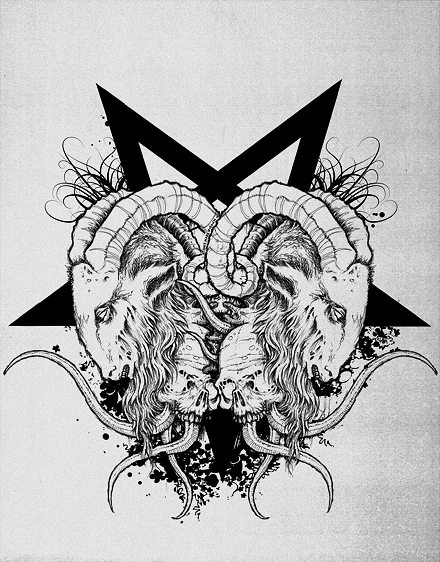
I have been interested in the history of Baphomet whose head appears in the Satanic inverted pentagram and why it is that he’s is refered to as a ‘sigil’ by many rather than a God.  His image was only introduced to Satanism when Anton LaVey officially introduced the world to the religion in 1966.  Before that time, inverted crosses were a symbol of Satanism and LaVey had purely revived the image from its gaudy history.
 Eliphas Levi's image

As a ‘sigil’ he is a cluster of occult semiotics with symbols also seen in alchemical texts, such as the text written on his arms in Eliphas Levi’s drawing of him reading ‘SOLVE – COAGULA’ meaning: ‘solution and coagulation’ as the alchemical process becomes the spiritual path.  Levi had used the Tarot deck’s ‘Devil’ card along with images of Mendes: The Baphomet of Egypt, to create this image.  The Egyptian Baphomet would fornicate with his worshippers, hence this 'bad' or 'evil' association with Witches which Goya has depicted in his image as Witches are seen worshipping a he-goat - which could really be just a goat.
 
Goya
Witches Sabbath
Oil on canvas
1798


The Knights Templar (France, est. 1119-1188) were said to worship Baphomet and when asked about it, only 12 out of the 251 knights – who had been interrogated by the Church – actually knew who the God was and acknowledged the worship.  They were also known as The Order of the Temple.  The Knights Templar were accused of homosexuality, urinating on the cross, of heresy and worshipping a god which they would cover in the fat of murdered children.  Whether any of that is true is hard to say.  The official symbol of the knights was a white flag with a crimson cross to symbolise the Christian war against the infidels.  The Templars were astute businessmen who managed to raise funds very well to support their holy mission.  This in combination with their intense secrecy and their transactions with the enemy during times of truce which was not a wise idea.  Some believe that the Templars took on some Gnostic rituals which could have included homosexuality, but there is no evidence to prove this, and it is more likely that their business transactions and secrecy were a deadly combination to see many of them killed under trial in 1310.  It is believed that their deaths were brought on by a King who could not pay them back and made them confess to heresy.  Many were killed on Friday the 13th and some say that that is where the belief in it being an unlucky day comes from.

Aleister Crowley had once joined the ‘Ordo Templis Orientis’ or ‘Order of Oriental Templars’ which was modelled after Freemasonry – which is also said to have a history with the sigil of Baphomet.  If you ever wondered about the cult depicted in the film Eyes Wide Shut, this group is most likely the reality of the film, although the rituals are very secret and there are seven stages to pass through.  Founded in Germany in 1896, the group practice sex magick as a form of spiritual enlightenment but they are not associated with Satanism or Wicca and the higher members of the order practice the sex magick whilst the others are trained spiritually. The ‘O.T.O’ still exists today, and on the Australian website they carry Crowley’s most famous rede from The Book of the Law: ‘Do what thou wilt shall be the whole of the law’ along with ‘love is the law, love under will.’  As many know, the first half had been interpreted by Gerald Gardener, the founder of modern Wicca in 1953 when he used a great deal of information from Crowley, including this, to create the Witch’s rede ‘Do what thou wilt, but harm ye none’ which combines with the Threefold Law of ‘Whatever you send you, you will get back times three.’  No wonder so many people are confused about Witchcraft and its other associations!

On the OTO website for Australia, there is no reference of sex:
Ordo Templi Orientis
Grand Lodge of
Australia

"Ordo Templi Orientis Australia (O.T.O.) is the subsidiary national Association for Australia of Ordo Templis Orientalis Headquarters. We are a religious Order that teaches and promotes the doctrines and practices of the philosophical and religious system known as Thelema, with a particular emphasis on cultivating the ideals of individual liberty, self-discipline, self-knowledge, and universal brotherhood. We do this through sacramental and initiatory rites, guidance and instruction, social and cultural events, and educational and community service activities. Please click the following link to view O.T.O. Australia's Statement of Objects"

SO after all of that, we can see that the only association that relates to Wicca is the Wiccan rede: ‘Do what thou wilt, but harm ye none.’  It is incredible to see how particular references and semiotics are juggled within the occult itself and land in the most perculiar of places!  I have to admit, I feel unsettled by some of the information that I’ve come across here in a strange way, not that I ought to be!

 
Mark Riddick's contemporary interpretation of Baphomet


Blessed Be,
)O( Elspeth

References:
The Encyclopedia of Witches and Witchcraft by Rosemary Ellen Guiley
An A to Z of the Occult by Simon Cox and Mark Foster
Church of Satan - The History of the Origin of The Sigil of Baphomet and its use in the Church of Satan http://www.churchofsatan.com/Pages/BaphometSigil.html

Thursday, January 28, 2010

Hecate - The Triple Goddess

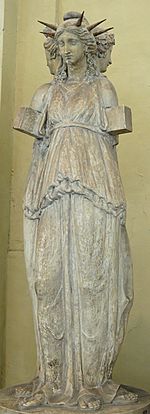
Hecate (pronounced he-KA-taye), the Patroness/Goddess of Witchcraft is the Goddess that stands on the cross roads patrolling the frontier between life and death, roaming the night with her hounds - and hails from ancient Turkey.  The daughter of Titan and confidante of Persephone and is often depicted as having three heads or three dog's heads or the heads of a dog, horse and snake.  She is supposed to see every crime at night time and can be called upon for justice against these crimes, winning a battle and to heal.


She was later adopted by Greek mythology, she was originally the prime Goddess of Caria which is now western Turkey.  She is the guardian of Istanbul having saved its people from the wrath of King Phillip II of Macedonia in 304BCE who was meant to attack on the dark of the moon, and Hecate, knowing this lit the sky with a crescent moon for one night whilst getting the Byzantines out of Istanbul before disaster struck.  In remembrance of her they put a crescent moon and two stars on their coins which still survives on the flag of Turkey.

Offerings are made to her by leaving food a the crossroads.

Tuesday, January 19, 2010

Kali - Creator and Destroyer


Fiona Horne recommended calling upon Kali for when you want to 'get the dross out of your life.'


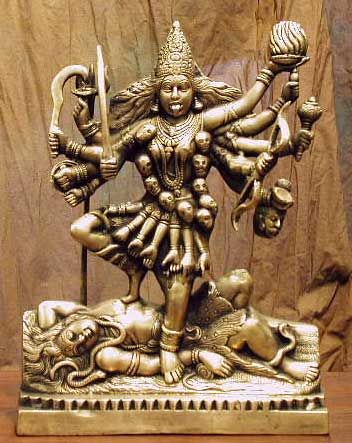
Kali is the fearful and ferocious form of the mother goddess. She assumed the form of a powerful goddess and became popular with the composition of the Devi Mahatmya, a text of the 5th - 6th century AD. Here she is depicted as having born from the brow of Goddess Durga during one of her battles with the evil forces. As the legend goes, in the battle, Kali was so much involved in the killing spree that she got carried away and began destroying everything in sight. To stop her, Lord Shiva (her husband) threw himself under her feet. Shocked at this sight, Kali stuck out her tongue in astonishment, and put an end to her homicidal rampage. Hence the common image of Kali shows her in her mêlée mood, standing with one foot on Shiva's chest, with her enormous tongue stuck out. 

Some say that Lord Shiva changed himself into the form of a plump baby when he threw himself at her feet and from there she took him and suckled him as the Dark Mother.  Later in the evening he transformed back into himself and convinced her to join him and others in the dance of creation.

The Hindu goddess who lives in crematoriums is depicted as an agressive 'Dark Mother' dressed in a girdle of dead men's arms and adorned with a necklace of skulls she does not discriminate when destroying - unless you're a worshipper.  As a worshipper you are taken on as a child to the Dark Mother who can be called upon to 'kill off' negativity surrounding you and on her flip side can be called upon for fertility.  She has eight arms (four on each side), one holding a sword, the other a demon's head with a remaining two to bless her worshippers, two arms are dead to hold earrings and the rest hold forms of weapons.  She is sometimes seen with blood on her face and chest as she drinks from a skull cup of blood.

Kali's four arms represent the complete circle of creation and destruction, which is contained within her. She represents the inherent creative and destructive rhythms of the cosmos. Her right hands, making the mudras of "fear not" and conferring boons, represent the creative aspect of Kali, while the left hands, holding a bloodied sword and a severed head represent her destructive aspect. The bloodied sword and severed head symbolize the destruction of ignorance and the dawning of knowledge. The sword is the sword of knowledge, that cuts the knots of ignorance and destroys false consciousness (the severed head). Kali opens the gates of freedom with this sword, having cut the eight bonds that bind human beings. Finally her three eyes represent the sun, moon, and fire, with which she is able to observe the three modes of time: past, present and future. This attribute is also the origin of the name Kali, which is the feminine form of 'Kala', the Sanskrit term for Time.

Sunday, December 6, 2009

The Goddess Sophia - 'Lady Wisdom' and Goddess of the occult

A bit of education for a change, considering how slack I've been!

I'll also have more on visualisation once I have my book of shadows back from my old house as I'm halfway from one place to the other to the other again.

Funnily enough, Sophia is not mentioned very often and sits on the fence between Christian and Pagan religions. Originally as a Gnostic goddess, the 'Lady of Divine Wisdom' takes her name from the Hebrew 'Hochma' or 'Wisdom.' In Greek, Sophia literally translates to 'Wisdom.' She appeared in 'The Wisdom of Solomon' by an Alexandrian Jew in approx 30BC, was present at creation and was God's bride... certainly not something which is well known as she is seen in the image below from the Sistine Chapel holding up God's arm and supporting his work. The Seal of Solomon itself is said to go back to the Bronze Age which is a part of Kabbalistic magickal tradition and has been used in Hermetics (alchemy), containing the Star of David.

Photobucket
The Seal of Solomon which contains a great deal of astrological and Hermetic symbols, including Ourobouros

She is venerated as the goddess of truth, wisdom and the occult mysteries... or apparently the occult mysteries according to Fiona Horne. She is depicted with a book in her left arm and a dove coming out of her heart. So how at the end of this can we connect her to the 'occult mysteries'? Is it because of her links to the book of Solomon which leads us to the Kabbalah and Hermetic traditions, or because she is so relatively unknown except for in Eastern Europe?

Another source leads us to some interesting information (via Northernway):
First, Sophia is developed from the context of modern life and real people, but in conversation with the historical and mythological. Second, the dark side is confronted through analysis of Sophia's "Other" faces, Lilith and Hecate, locating it as the source of individual power and knowledge. Third, it provides modern women with an image of female power that is not based solely on reproduction and mothering but on another aspect of the feminine archetype rarely discussed--the intelligence and cosmic power of the life force. Finally, it introduces the "path of crumbs" which encourages women to direct their own life through recognition of the guidance present in circumstances.

So perhaps she was another Goddess to be omitted from the majority of Western Christian tradition like Lillith? How and why she is linked to Hecate is unclear but certainly interesting.

Photobucket
Sophia and her three daughters: Faith, Hope and Love (other sources say they are 'Faith, Hope and Charity')

Photobucket
Mark Ryden's contemporary depiction in 'Sophia's Mercurial Waters'

Photobucket
The woman under God's arm is said to be Sophia (from the ceiling of the Sistine Chapel)

Photobucket
Alex Grey's interpreration of Sophia


Literary sources:

The Encyclopedia of Spirits by Judika Illes
The Encyclopedia of Witches and Witchcraft by Rosemary Ellen Guiley


Tuesday, May 12, 2009

Odin, the God of Wednesday

Above: an image of Odin and his one all-seeing eye pointing outwards. Artist unknown. Source: http://tinyurl.com/ossff2

I really needed to know more about Odin and his 'all-seeing eye' and I am enraptured with this God! His story is so romantic and chilling as the God of all Norse Gods who can 'make the dead speak to question the wisest amongst them.'


Odin

by Micha F. Lindemans
from http://www.pantheon.org/articles/o/odin.html

The chief divinity of the Norse pantheon, the foremost of the Aesir. Odin is a son of Bor and Bestla. He is called Alfadir, Allfather, for he is indeed father of the gods. With Frigg he is the father of Balder, Hod, and Hermod. He fathered Thor on the goddess Jord; and the giantess Grid became the mother of Vidar.
Odin
Odin is a god of war and death, but also the god of poetry and wisdom. He hung for nine days, pierced by his own spear, on the world tree. Here he learned nine powerful songs, and eighteen runes. Odin can make the dead speak to question the wisest amongst them. His hall in Asgard is Valaskjalf ("shelf of the slain") where his throne Hlidskjalf is located. From this throne he observes all that happens in the nine worlds. The tidings are brought to him by his two raven Huginn and Muninn. He also resides in Valhalla, where the slain warriors are taken.
Odin's attributes are the spear Gungnir, which never misses its target, the ring Draupnir, from which every ninth night eight new rings appear, and his eight-footed steed Sleipnir. He is accompanied by the wolves Freki and Geri, to whom he gives his food for he himself consumes nothing but wine. Odin has only one eye, which blazes like the sun. His other eye he traded for a drink from the Well of Wisdom, and gained immense knowledge. On the day of the final battle, Odin will be killed by the wolf Fenrir.
He is also called Othinn, Wodan and Wotan. Some of the aliases he uses to travel icognito among mortals are Vak and Valtam. Wednesday is named after him (Wodan).

Thursday, May 7, 2009

Eqyptian & Greek Gods

Above image of Sekhmet from The Center of Light

http://www.touregypt.net/godsofegypt/index.htm

I had no idea how many Egyptian gods there were, including Sekhmet, whom I'm a small fan of:

Sekhmet
Patron of: divine retribution, vengeance, and conquest.
Appearance: a woman with the head of a lioness.
Description: Sekhmet means "The Mighty One," and she was one of the most powerful of the gods and goddesses. She was the goddess who meted out divine punishment to the enemies of the gods and of the pharaoh. In this capacity she was called the "Eye of Ra." She also accompanied the pharaoh into battle, launching fiery arrows into battle ahead of him. Sekhmet could also send plagues and disease against her enemies, but was sometimes invoked to avoid plague and cure disease.
Sekhmet's capacity for destruction is well-documented. In one story, Ra sends her to punish those mortals who have forgotten him and she ends up nearly destroying the entire human race. Only the cleverness of Ra stops her rampage before it consumes every living thing.
Worship: Worshipped as part of a triad made up of herself, her husband Ptah and their eldest child Nefertem, her cult center was at Memphis.


With short blurbs on each god, this site is more of a jumping-off point rather than providing the entire mythical story of each diety. Some stories are provided, such as the Birth of Athena and more information is available on classic Greek literature:

http://www.greekmythology.com/

Great website for Goddess education

http://www.goddess.com.au/

Rarely do you come across anything as informative as this site. Anita Revel's research provides the witch with great detail and the origin of the Goddess within each culture, such as:

Inanna is the Sumerian goddess, honoured at the dark moon, as it is she who fixes destinies at each new moon. Inanna's journey into the underworld and subsequent revitalisation represents the soul's evolution through hardship into glorious renewal.
In her quest for clarity and knowledge, Inanna Queen of Heaven and Earth descended to Earth to rule her people, where (so that her people would not know hunger) she made a sacred marriage to ensure the fertility of the lands. She thirsted to understand first-hand though, the true sufferings of her followers, so she descended again, this time to the realm of the underworld, the domain of her sister Ereshkigal....

The majority of the website hosts a list of Goddesses on the right hand side - a great deal I'd never heard of - which she has gone into great detail on from Egyptian, Welsh, Sumerian and many other cultures.